
Grind Size Mastery: Matching Your Grind to Your Brew Method


You can have the best specialty coffee beans in the world, perfect water, and precise brewing technique—but if your grind size is wrong, your coffee will disappoint every time. Grind size is arguably the most important brewing variable you control at home, yet it’s also the most misunderstood. Too fine, and you’ll extract bitter, astringent flavors. Too coarse, and you’ll end up with weak, sour coffee that tastes underdeveloped. The good news? Once you understand how grind size works and how to match it to your brewing method, you’ll unlock consistent, delicious coffee every single time.
In this guide, you’ll master the science of particle size, learn visual references for every brew method, troubleshoot common extraction problems, and discover how to dial in your grinder for optimal flavor from your specialty coffee.
The Science of Particle Size
Grind size controls extraction by determining how much surface area of the coffee grounds is exposed to water. Finer grinds have more surface area, which means water can extract flavor compounds more quickly and efficiently. Coarser grinds have less surface area, so extraction happens more slowly. This relationship between particle size and extraction speed is the foundation of all coffee brewing.
But here’s what most home brewers miss: consistency matters more than hitting a “perfect” grind size. A grind with uniform particle size will extract evenly, producing balanced, clean flavors. A grind with inconsistent particles—some fine, some coarse—will extract unevenly. The fine particles over-extract (bitter, harsh), while the coarse particles under-extract (sour, weak). The result is a muddy, unbalanced cup that tastes simultaneously bitter and sour.
This is why grinder quality matters so much. Cheap blade grinders produce wildly inconsistent particle sizes, making it nearly impossible to dial in your coffee. Burr grinders, on the other hand, crush beans between two surfaces to create uniform particles, giving you control and consistency.
Grind distribution refers to the range of particle sizes in your ground coffee. Even high-quality burr grinders produce some “fines” (very small particles) and “boulders” (larger chunks). The goal is to minimize this variation. A tight grind distribution means most particles are the same size, leading to even extraction and better-tasting coffee. This is why serious coffee enthusiasts invest in quality grinders—it’s not about perfection, it’s about consistency.
Visual Grind Size Guide
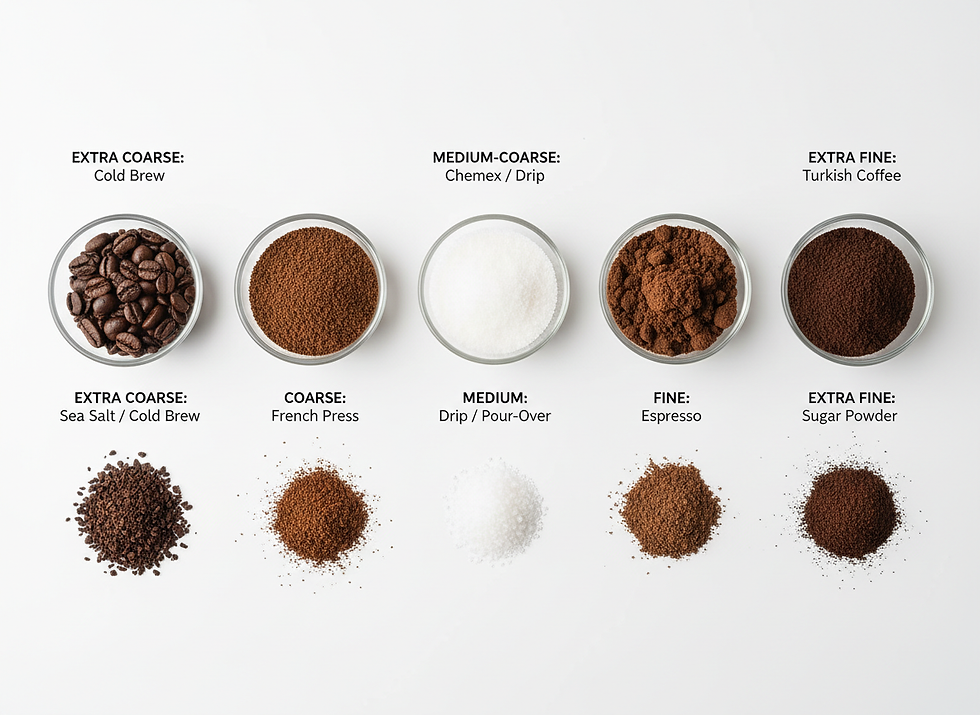
Matching your grind size to your brewing method is essential for balanced extraction. Here’s a detailed breakdown of grind sizes, what they look like, and which brew methods they’re best suited for:

Extra Coarse (Cold Brew, Cowboy Coffee)
Texture: Like raw sugar or peppercorns
Particle size: 1.5–2mm
Why: These methods use very long brew times (12–24 hours for cold brew), so a coarse grind prevents over-extraction and bitterness. The large particles allow slow, gentle extraction of sweet, smooth flavors.
Coarse (French Press, Percolator)
Texture: Like sea salt or breadcrumbs
Particle size: 1–1.5mmBest for: French press, percolator, coffee cupping
Why: French press uses a 4-minute steep with full immersion. A coarse grind prevents over-extraction and keeps fines from passing through the metal mesh filter. Too fine, and you’ll get sludgy, bitter coffee.
Medium-Coarse (Chemex, Clever Dripper)
Texture: Like coarse sand or kosher salt
Particle size: 0.75–1mm
Why: Chemex uses thick paper filters that slow water flow, so a slightly coarser grind compensates for the longer contact time. This grind size balances clarity and body.
Medium (Drip Coffee Makers, Pour-Over)
Texture: Like regular sand or granulated sugar
Particle size: 0.5–0.75mm
Why: This is the most common grind size for everyday brewing. It works well with standard drip machines and pour-over methods that have moderate flow rates and 3–4 minute brew times.
Medium-Fine (V60, Aeropress)
Texture: Like fine sand or table saltParticle size: 0.4–0.5mm
Best for: Hario V60, Aeropress (standard method), cone-shaped pour-overs
Why: The V60’s large opening and thin filter allow faster flow, so a finer grind increases contact time and extraction. Aeropress is versatile, but medium-fine works well for balanced, full-bodied brews.
Fine (Espresso, Moka Pot)
Texture: Like powdered sugar or flour
Particle size: 0.2–0.4mm
Why: Espresso uses high pressure and very short brew times (25–30 seconds), so a fine grind maximizes extraction in minimal time. Moka pots also need fine grinds to build pressure and extract properly.
Extra Fine (Turkish Coffee)
Texture: Like talcum powder or cocoa powder
Particle size: <0.2mm
Why: Turkish coffee is brewed by boiling ultra-fine grounds directly in water, then served unfiltered. The powder-like consistency allows full extraction and creates the signature thick, rich texture.
Visual reference tip: Compare your grounds to common kitchen ingredients (sea salt, table salt, sugar, flour) to gauge consistency. Take photos of your grind settings for each brew method so you can replicate results.
Grinder Types and Their Impact
The type of grinder you use has a massive impact on grind consistency, flavor, and your ability to dial in your coffee. Here’s what you need to know:
Blade Grinders: Pros, Cons, and Limitations
Blade grinders use a spinning blade to chop beans, similar to a blender. They’re inexpensive ($15–30) and widely available, but they produce highly inconsistent particle sizes. You’ll get a mix of fine powder and large chunks, leading to uneven extraction. Blade grinders also generate heat, which can degrade flavor. If you’re serious about specialty coffee, a blade grinder is your biggest limitation.
Burr Grinders: Flat vs. Conical
Burr grinders crush beans between two surfaces (burrs) to produce uniform particle sizes. They come in two types:
Conical burrs: Cone-shaped burrs that grind beans vertically. They’re quieter, generate less heat, and are more affordable. Great for home use and all brew methods.
Flat burrs: Two parallel rings that grind beans horizontally. They produce slightly more uniform particles and are preferred for espresso, but they’re louder and more expensive. Both types are excellent for specialty coffee. The key is choosing a grinder with quality burrs and a wide range of grind settings.

Hand Grinders vs. Electric
Hand grinders (like the Hario Skerton, Timemore, or Comandante) are affordable, portable, and produce excellent grind consistency. They’re ideal for single servings and travel. The downside? Grinding takes effort and time (1–2 minutes per dose). Electric burr grinders (like the Baratza Encore or Fellow Ode) are faster and more convenient, especially if you’re brewing multiple cups daily.
When to Upgrade Your Grinder
Upgrade if:
- You’re using a blade grinder and want better flavor
- Your current grinder doesn’t offer fine enough adjustments for your brew method
- You’re getting inconsistent results despite dialing in other variables
- You’re ready to explore espresso (which requires a high-quality grinder)
A good burr grinder is the single best investment you can make in your coffee setup. It will improve your coffee more than any other piece of equipment.
Maintenance and Calibration Tips
- Clean your grinder every 2–4 weeks to remove oils and residue (use grinder cleaning tablets or rice)
- Check burrs for wear annually; replace if dull or chipped
- Calibrate your grinder by testing grind settings with the same coffee and brew method, adjusting until you achieve balanced extraction
- Keep a log of grind settings for different coffees and brew methods
Troubleshooting Through Grind Adjustment
Grind size is your primary tool for fixing extraction problems. Here’s how to diagnose and adjust:

Too Sour or Acidic?
This indicates under-extraction—not enough flavor compounds have been pulled from the coffee. The water passed through too quickly or didn’t extract enough soluble material.
Solution: Grind finer. Smaller particles increase surface area and slow water flow, allowing more extraction. Adjust in small increments (1–2 clicks on your grinder) and taste.
Too Bitter or Harsh?
This indicates over-extraction—too many compounds (including unpleasant ones) have been extracted. The water spent too much time in contact with the grounds or extracted too aggressively.
Solution: Grind coarser. Larger particles reduce surface area and speed up water flow, decreasing extraction. Again, adjust gradually.
Weak or Watery Coffee?
This can be caused by under-extraction (grind too coarse) or simply not enough coffee.
Solution: First, check your coffee-to-water ratio. If that’s correct, grind finer to increase extraction strength.
Uneven Extraction Signs
If your coffee tastes simultaneously sour and bitter, you likely have inconsistent grind size. Fine particles over-extract while coarse particles under-extract.
Solution: Upgrade to a burr grinder for consistency. If you already have one, check for wear or calibration issues.
Step-by-Step Adjustment Process:
1. Brew a cup with your current grind setting and taste critically
2. Identify the dominant flaw (sour, bitter, weak, etc.)
3. Adjust grind size by 1–2 clicks in the appropriate direction
4. Brew again with the same coffee, water, and technique
5. Taste and compare
6. Repeat until balanced
Patience is key. Small adjustments make big differences, especially with espresso and pour-over methods.
Advanced Grinding Techniques
Once you’ve mastered the basics, these advanced strategies will help you fine-tune your coffee for even better results:

Grinding for Different Water Temperatures
Higher water temperatures extract more efficiently, so if you’re brewing hotter (200–205°F), you may want to grind slightly coarser to avoid over-extraction. Conversely, cooler water (195–200°F) extracts more slowly, so a slightly finer grind can compensate.
Adjusting for Coffee Age and Roast Level
Freshly roasted coffee (within 1–2 weeks of roast date) is more soluble and extracts faster, so you may need a slightly coarser grind. As coffee ages (3–4 weeks post-roast), it becomes less soluble, so grinding finer can help maintain extraction. Light roasts are denser and less porous, requiring finer grinds and longer brew times. Medium and dark roasts are more porous and extract faster, so coarser grinds often work better.
Seasonal Grinding Adjustments
Humidity affects coffee beans. In humid environments, beans absorb moisture and grind differently (often finer than expected). In dry conditions, beans may grind coarser. If you notice seasonal changes in your coffee’s flavor, slight grind adjustments can help.
How small beanz coffee co. Roasts Respond to Different Grinds
Our light-to-medium roast specialty coffees are designed to highlight origin characteristics and complex flavor profiles. Because we roast on the lighter side, our beans benefit from slightly finer grinds and longer extraction times compared to darker roasts. For pour-over methods like V60, aim for medium-fine. For French press, stay at the coarser end but don’t be afraid to go slightly finer than you would with a darker roast. The goal is to fully develop sweetness and acidity without under-extracting. Experiment and taste—you’ll find the sweet spot where our coffees shine.
Storage and Freshness
Grind size matters, but so does freshness. Here’s how to preserve your coffee’s flavor:
Why Pre-Grinding Kills Flavor
Once coffee is ground, it begins losing flavor rapidly due to oxidation and CO₂ loss. Ground coffee has exponentially more surface area exposed to air than whole beans, accelerating staling. Within 15–30 minutes of grinding, you’ll notice a decline in aroma and flavor. Pre-ground coffee (even from a specialty roaster) will never taste as vibrant as freshly ground.
Proper Storage of Whole Beans
Store whole bean coffee in an airtight container in a cool, dark place. Avoid the fridge or freezer unless you’re storing beans long-term (in which case, freeze in airtight bags and thaw completely before opening). Use coffee within 2–4 weeks of the roast date for peak flavor.
Grinding Timing for Optimal Freshness
Grind your coffee immediately before brewing—ideally within 1–2 minutes of contact with water. This preserves volatile aromatics and ensures maximum flavor. If you must grind in advance (for convenience or travel), store ground coffee in an airtight container and use within 24 hours.
Conclusion & Practice
Mastering grind size is one of the most impactful skills you can develop as a home brewer. By understanding the science of extraction, matching your grind to your brew method, and learning to troubleshoot through adjustment, you’ll consistently brew better coffee with the specialty beans you love.
Key takeaways: - Consistency matters more than perfection
—invest in a quality burr grinder
- Match your grind size to your brew method and adjust based on taste
- Grind fresh, right before brewing, for maximum flavor
- Small adjustments make big differences
—be patient and taste critically
Ready to put this into practice? Start experimenting with your current setup this week. Brew the same coffee at different grind settings and taste the differences. You’ll quickly develop an intuition for how grind size affects flavor.
Want hands-on guidance? Join us for our Become a Better Brewer class at small beanz coffee co., where we’ll explore grind size, extraction, and brewing techniques together. You’ll taste side-by-side comparisons, dial in your own grinder, and leave with the skills to brew exceptional specialty coffee at home every single day.
Sign up for a coffee education course and explore our current coffee offerings at smallbeanzcoffeeco.com
Let’s grind, brew, and taste something amazing together. ☕


Comments