
Is Your Coffee 'Mold Free'? The Truth About Mycotoxins and Ochratoxins

Disclaimer:This article is for informational and educational purposes only and does not constitute medical, health, or scientific advice. While we reference scientific studies and regulatory standards (such as the FDA and EU), individual results and toxin levels can vary. small beanz coffee co. products are not intended to diagnose, treat, cure, or prevent any disease or health condition. Always consult with a healthcare professional regarding your specific health concerns.

If you’ve spent any time on wellness blogs or health-focused Instagram lately, you’ve probably seen the scary headlines: "Is your coffee making you sick?" or "The hidden mold in your morning mug." These posts often claim that most coffee is riddled with toxic molds and that you need to buy a specific, high-priced "mold-free" brand to stay safe.
At small beanz coffee co., we’re all about making specialty coffee approachable, and that includes clearing up the confusion around high-quality coffee and specialty standards.
Here’s the thing: while mycotoxins are a real scientific concept, the "moldy coffee" narrative is often more about marketing than it is about your health. As a recipient of both the SCA Roastery and Coffee Trade Diplomas and a Certified Q Grader at the helm, we believe you deserve the science, not the scare tactics.
In this guide, we’re going to break down what these toxins actually are, why specialty coffee is inherently lower risk, and how you can brew with total confidence.
The "What, Who, and How" of Coffee Contaminants
Before we dive into the deep end of the science, let's categorize the situation:
What is it? A discussion about Ochratoxins and Mycotoxins, naturally occurring byproducts of certain molds that can grow on agricultural crops, including coffee cherries.
Who is this for? Health-conscious coffee lovers, everyday home brewers, and anyone who has ever felt a little nervous after seeing an ad for coffee marketed as uniquely "mold-free."
How to use this info? Use this knowledge to vet your coffee sources. Instead of looking for a "label," look for quality standards and transparency in the roasting process.
What are Mycotoxins and Ochratoxins?
Let’s get technical for a second. Mycotoxins are toxic compounds produced by certain types of fungi (molds). The specific mycotoxin that most frequently pops up in coffee discussions is Ochratoxin A (OTA).
OTA is produced by species of Aspergillus and Penicillium. These molds don't just hang out on coffee; they are found on almost everything in your pantry, grains, dried fruits, wine, and spices.
The Reality Check: Yes, OTA is real. Yes, it can be found in coffee. However, "detectable" may not be the same as "dangerous." Modern scientific studies show that while OTA might be detected in some coffee samples, the levels are consistently well below safety limits set by regulatory bodies like the EU and the FDA.

Why Specialty Coffee is Inherently Lower Risk
The secret to high-quality, specialty coffee isn't only a proprietary lab test: it starts with quality control. At the specialty level, we follow a rigorous set of standards that naturally eliminate the conditions where mold thrives.
1. Selective Sourcing and High Altitudes
Molds love heat and humidity. Most specialty coffee is grown at high altitudes, where the air is cooler and the environment is less hospitable to fungal growth. Furthermore, specialty farmers use selective picking, meaning they only harvest ripe, healthy coffee cherries. Mold and toxins are most commonly found in over-ripe, damaged, or fermented "floor" fruit: the kind of beans that get swept up in mass-market, commercial coffee production, but are strictly excluded from specialty batches.
2. The "Wet" Process Advantage
There are two main ways to process coffee: Natural (Dry) and Washed (Wet).
Washed process involves removing the fruit and washing the beans in water before drying them. This significantly reduces the risk of mold because the "food" for the mold (the sugary mucilage) is washed away immediately.
Even in natural processing, specialty producers use raised drying beds to ensure constant airflow, preventing the moisture buildup that leads to mold.
3. SCA Grading Standards
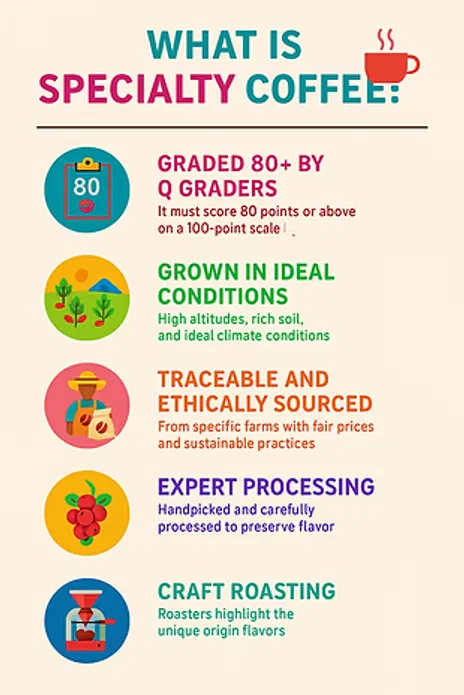
This is where it gets serious. We only deal with beans that have been graded as "Specialty."
A Certified Q Grader (like ours!) inspects the green coffee for "primary defects." Guess what qualifies as a defect? Fungal damage. If a coffee lot has mold or significant defects, it cannot be graded as specialty. By choosing specialty-grade beans, you are choosing coffee that has already passed a rigorous physical inspection for health and quality. By following SCA defect standards, we strictly screen for fungal damage at the green bean level, which is the most effective way to ensure a high-quality, low-contaminant cup.
The Roasting Fire: Nature’s Purifier
Even if a tiny amount of mold spores were present on the green beans, they face a formidable enemy: the roasting process.
Roasting isn't just about developing those citrusy or chocolatey notes; it’s a high-heat environment that acts as a natural disinfectant. Studies have shown that the intense heat of a coffee roaster (reaching upwards of 400°F) destroys 69% to 96% of Ochratoxin A.
What the Research Shows About OTA and Roast Degree
A 2009 Food Control study by Almeida et al. found that roasting can reduce Ochratoxin A (OTA) by up to 98%, depending on the degree of roast. While studies like Almeida et al. (2009) show significant reduction in OTA during roasting, it’s important to note that specific results can vary based on roast profile, equipment, and bean density. In plain English: as the roast gets deeper, the combination of heat and time gives OTA more opportunity to break down.
The same study described OTA destruction as following first-order kinetics. That sounds technical, but the takeaway is simple: the longer and hotter the roast environment, the more OTA degrades over time. It’s one more reason roasting is such a powerful natural purifier.
That said, roasting should be viewed as a strong backup layer, not the only safety net. At small beanz coffee co., our SCA standards for green coffee are still the first and best line of defense. We start with specialty-grade coffees that are already screened for defects like fungal damage, then use careful small-batch roasting to further protect quality in the cup.
By the time the coffee reaches your cup, any residual toxins are typically at levels so low they are biologically insignificant. You can learn more about how we manage heat and flavor in our guide to The Art of Coffee Roasting.
Marketing Hype vs. Scientific Reality
So, why do companies push the "mold-free" label so hard?
It’s a classic marketing tactic: identify a fear and sell the solution. By labeling a coffee as uniquely "mold-free," brands can charge double or triple the price for a product that most specialty roasters are already providing through solid sourcing, processing, and quality standards.
When a brand says their coffee is "tested for mycotoxins," it sounds impressive. But the truth is that almost all high-quality, specialty coffee would pass those same tests with flying colors. The quality of the coffee is a byproduct of ethical sourcing and excellent processing, not just a lab result.
The Quality Coffee Checklist:
Grade: Is it Specialty Grade (80+ points)?
Freshness: Is it roasted in small batches? (Old, stale coffee in damp warehouses is where mold actually becomes a risk).
Transparency: Can you trace it back to a specific farm or origin? Check out our post on decoding coffee labels for more on this.
Pro Tips: How to Keep Your Coffee High-Quality at Home
Even the best beans can run into trouble if they aren't handled correctly once they arrive at your door. Here’s how to maintain that quality:
Store it Dry and Dark: Moisture is the enemy. Keep your beans in an airtight container (like the resealable bags we provide) in a cool, dark place. Never store coffee in the fridge or freezer, as condensation can introduce the very moisture that encourages mold growth.
Buy Whole Bean: Whole beans have a smaller surface area exposed to the air than ground coffee. This keeps them fresher longer and prevents oxidation.
Check the Roast Date: Freshness is a key indicator of quality. We roast in small batches to ensure your coffee hasn't been sitting in a humid warehouse for months.
Clean Your Equipment: Mold can grow in your coffee maker’s water reservoir or the "sludge" in an unwashed carafe. Regularly descale and clean your gear. Need help? See our home brewing guide.
Pro Tip: If reducing OTA is top of mind for you, dark roasts plus a coarse grind can be a surprisingly effective combo. A 2013 study in Food Control found this pairing resulted in up to a 97% reduction. That doesn’t mean dark roast is "better" across the board; roast level is always about preference and purpose. But if you love those deeper, chocolatey, heavy-bodied profiles, it’s a nice bonus to know that darker roasting and coarser grinding may help lower OTA even further.
The Bottom Line: Brew with Confidence
At the end of the day, coffee should be a source of joy, not anxiety.
The "mold-free coffee" trend has done a great job of highlighting the importance of quality, but it has also created unnecessary fear. When you buy from a reputable specialty roaster who focuses on traceability and SCA standards, you are already buying coffee shaped by high-quality, low-risk specialty practices.
At small beanz coffee co., we take the technical stuff seriously: our certifications, our sourcing, and our small-batch roasting: so that you don’t have to worry about what’s in your cup. Whether you're sipping a bright and wine-like Ethiopian single-origin or a heavy-bodied specialty blend, you can rest easy knowing it was handled with the highest level of care from farm to flask, prioritizing quality and standards every step of the way.
Ready to taste the specialty difference? Explore our latest roasts and experience coffee that reflects specialty standards in every cup.
Summary of Key Takeaways
Mycotoxins and Ochratoxins are real, but detectable levels in coffee are, in most cases, well below safety limits.
Specialty Coffee naturally avoids toxins through high-altitude growing, selective picking, and superior processing (like the washed method).
Roasting destroys the vast majority of any potential contaminants through high-heat exposure, with research showing OTA reduction can reach up to 98% depending on roast degree.
"Mold-Free" labels are often a marketing tool rather than a scientific necessity for those already drinking specialty-grade coffee produced with strong quality standards.
Keep it Fresh: Your biggest defense against "bad" coffee is buying fresh, whole-bean specialty coffee and storing it properly.

Comments